Fuel Tax Credits
The Fuel Tax Credits (FTC) feature within ResTrack Lite assists organisations in identifying eligible vehicles and fuel usage for fuel tax credit reporting and compliance purposes.
Fuel Tax Credits are administered by the Australian Taxation Office (ATO) and allow eligible businesses to claim credits for the fuel tax (excise or customs duty) included in the purchase price of fuel used in business operations.
ResTrack Lite provides tools to help organisations track fuel usage, manage FTC eligibility, and generate reporting data required for Business Activity Statement (BAS) submissions and compliance record keeping.
What are Fuel Tax Credits?
Fuel Tax Credits are government rebates available to eligible businesses that purchase fuel for use in commercial activities.
Fuel Tax Credits generally apply to:
- Diesel and other taxable fuels
- Heavy vehicles with a Gross Vehicle Mass (GVM) greater than 4.5 tonnes
- Commercial transport operations
- Off-road plant and equipment
- Mining, construction, agriculture, and industrial activities
The amount claimable depends on several factors, including:
- Fuel type
- Fuel acquisition date
- Vehicle or equipment classification
- On-road or off-road fuel usage
- Applicable Road User Charges (RUC)
Heavy vehicles operating on public roads may have their FTC entitlement reduced by the applicable Road User Charge.
FTC Eligibility
Eligibility for Fuel Tax Credits is determined by the organisation’s operational activities and vehicle usage.
To claim Fuel Tax Credits, organisations generally must:
- Hold a valid Australian Business Number (ABN)
- Be registered for GST
- Be registered for Fuel Tax Credits with the ATO
- Maintain accurate fuel purchase and usage records
Within ResTrack Lite, FTC eligibility may be configured at the vehicle level to assist with reporting and compliance workflows.
Vehicles operating as heavy vehicles on public roads may require additional FTC considerations due to Road User Charge adjustments.
Vehicle FTC Configuration
Vehicle FTC settings are managed through the Vehicles page.
Administrators can configure:
- Fuel Tax Credit eligibility
- Heavy vehicle public road usage
- Vehicle categories
- Odometer or engine hour tracking
These settings are used to support FTC reporting calculations and compliance reporting outputs.
FTC Reporting
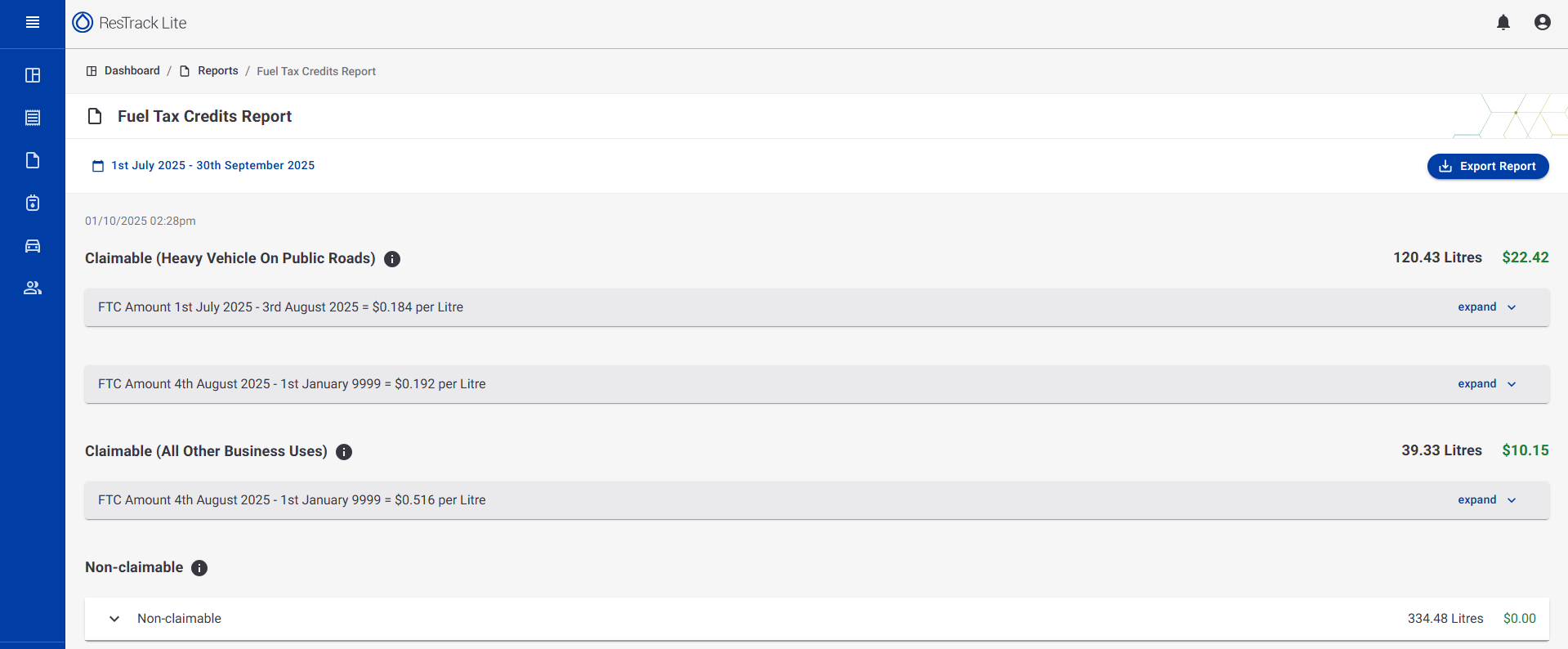
ResTrack Lite provides reporting tools to assist organisations with FTC calculations and BAS preparation.
The FTC reporting workflow generally includes:
- Collection of fuel transaction data
- Validation of vehicle eligibility
- Classification of fuel usage
- Application of current FTC rates
- Deduction of applicable Road User Charges
- Calculation of FTC entitlement values
- Generation of FTC summary reports
Record Keeping and Compliance
Organisations claiming Fuel Tax Credits should retain supporting records, including:
- Fuel purchase invoices
- Vehicle and fleet records
- Fuel allocation calculations
- Usage and distance records
- FTC summary reports
These records may be required for compliance reviews or audit verification by the Australian Taxation Office (ATO).